But Almost as Soon as the Green Came the World Turns Back to Brown Again
The tragic tale of Mt Everest's well-nigh famous dead body
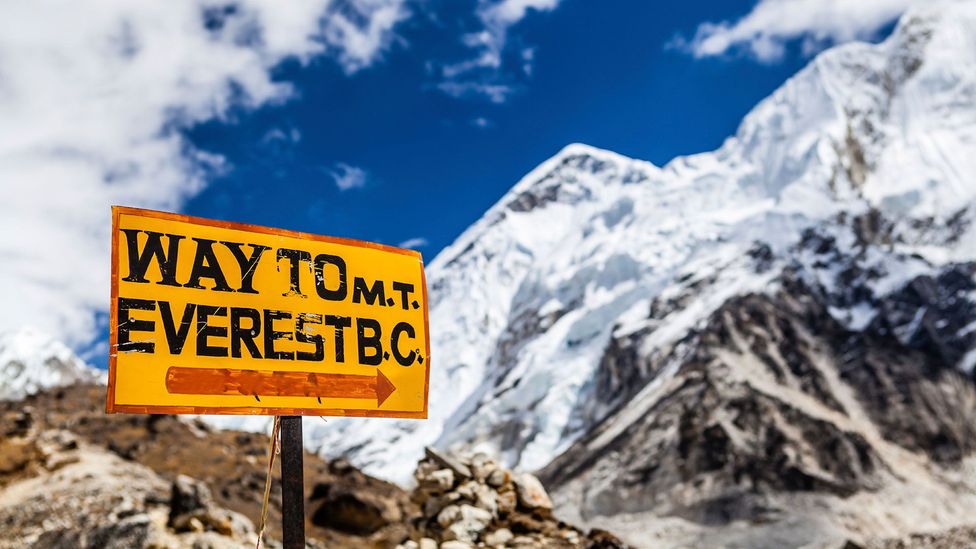
Mount Everest is home to more than 200 bodies. Rachel Nuwer investigates the sad and little-known story behind its near prominent resident, 'Green Boots' – and discovers the disturbing effects this mortiferous mountain tin can wreak on the mind and trunk.
T
This is role of BBC Hereafter's "Best of 2015" list, our greatest hits of the year.
-
"It is clear that the stake [the mountaineer] risks to lose is a neat one with him: it is a affair of life and death…. To win the game he has beginning to attain the mountain'south summit – just, further, he has to descend in safety. The more hard the manner and the more numerous the dangers, the greater is his victory."
- George Mallory, 1924
Equally though napping, the climber lies on his side under the protective shadow of an overhanging rock. He has pulled his red fleece up around his face, hiding information technology from view, and wrapped his arms firmly around his torso to ward off the bitter wind and cold. His legs stretch into the path, forcing passers-by to gingerly pace over his neon green climbing boots.
His name is Tsewang Paljor, but almost who encounter him know him just as Green Boots. For nearly twenty years, his body, located non far from Mountain Everest's summit, has served every bit a grim trail marking for those seeking to conquer the world's highest mount from its north face. Many have lost their lives on Everest, and like Paljor, the vast majority of them remain on the mount. But Paljor'south body, cheers to its prominence, came to be i of the most well-known.
"I would say that really everybody, specially those climbing on the due north side, knows almost Green Boots or has read about Greenish Boots or has heard somebody else talking about Green Boots," says Noel Hanna, an adventurer who has summited Everest seven times. "About 80% of people also take a residual at the shelter where Green Boots is, and it's difficult to miss the person lying in that location."
With Paljor's death came a wave of controversy, including whether he and his two teammates died because other climbers, in their own lust to reach the height, callously ignored their signs of distress. Scant information is available virtually the homo behind the nickname, however. Type "Green Boots" into a Google search and you will acquire that Paljor, along with climbing partners Tsewang Smanla and Dorje Morup, perished in the 1996 storm immortalised in Jon Krakauer's best-selling book Into Sparse Air and, more recently, the big-upkeep thriller Everest. Paljor, Wikipedia tells you, was a member of the Indo-Tibetan Border Constabulary, and was simply 28 years old when he lost his life.
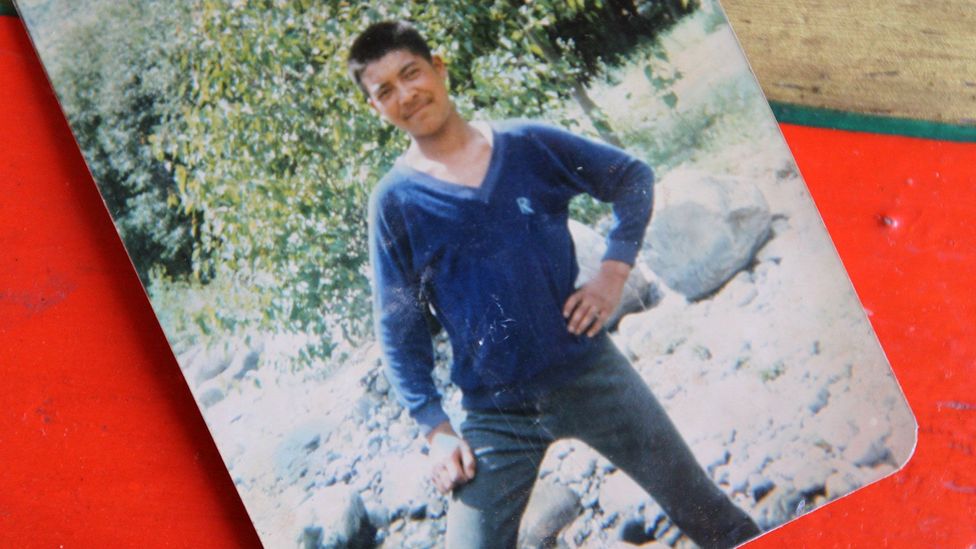
Tsewang Paljor, in younger days. Photographs by Rachel Nuwer.
I admit to feeling a certain morbid curiosity at the thought of Paljor and all the other fallen climbers on the mountain, stranded far from loved ones and frozen in time, forever displaying the moment of their decease. But more a fixation on the macabre, I wished to know the story of the handsome swain in the light-green boots – especially the circumstances that could let him to remain on the mountain for then many years.
I was also intrigued by what farthermost altitude can exercise to the human being trunk and mind, and the unexpected touch it can have on the decisions – and even ideals – of a person. But ultimately, I wanted answers to another, more pressing query; one that has been raised countless times but seems to evade explanation: why climb this mountain at all? Why gamble your life on its unforgiving slopes? According to the records of Alan Arnette, a mountaineer based in Colorado whose blog is a trusted source of Everest information, from 1924 to August 2015, 283 people take died on the mountain – 170 foreigners and 113 Nepalis – leading to an overall deaths-to-summit ratio of about iv%. How is it that so many people still see this endeavour every bit worthwhile?
My desire to answer these questions – in a two-part in-depth serial for BBC Futurity – led me down a rabbit hole of psychology, ethics and climbing culture; to the doorsteps of mountaineering legends and broken-hearted parents alike; to sources spanning Fukuoka, California and Kathmandu. This is my attempt to make sense of what I found.
A cheerful place
As the airplane lifts off and heads n from New Delhi, the city'southward smog, congestion and sprawl quickly fade from view, replaced by brown, rural flatness that in plow morphs into green hills and terraced fields.
Ladakh, "possessor of passes," which lies in the shadow of the Great Himalayas
The landscape, all the same, has only begun to grow in scale and splendour. Hills climb to always-greater heights, shaking themselves complimentary of villages, fields and vegetation – and then, any remnants of life. Jagged, snow-kissed mountain peaks stretch e'er higher, as though trying to pluck our tiny vessel from the sky. Here and at that place, a valley river punctuates the monochrome landscape with a ribbon of green, a lifeline in an otherwise impossibly inhospitable environment.
Nosotros've nearly reached our destination. The plane begins its descent, and the captain's voice crackles over the intercom: "I hope all of you have left all of your worries behind in Delhi, so you can have a great time in this cheerful place."
Nosotros're in the region of Ladakh, "possessor of passes," which lies in India's far north, in the shadow of the Great Himalayas. It's early September, when the days are vivid and warm only nights are already creeping beneath 0C.
It was hither, in this high distance desert at 3,800m (12,500ft), that Tsewang Paljor was born on April ten, 1968. He grew up in Sakti – "the gilt throne" – an idyllic valley village of whitewashed houses, barley fields and poplar trees.
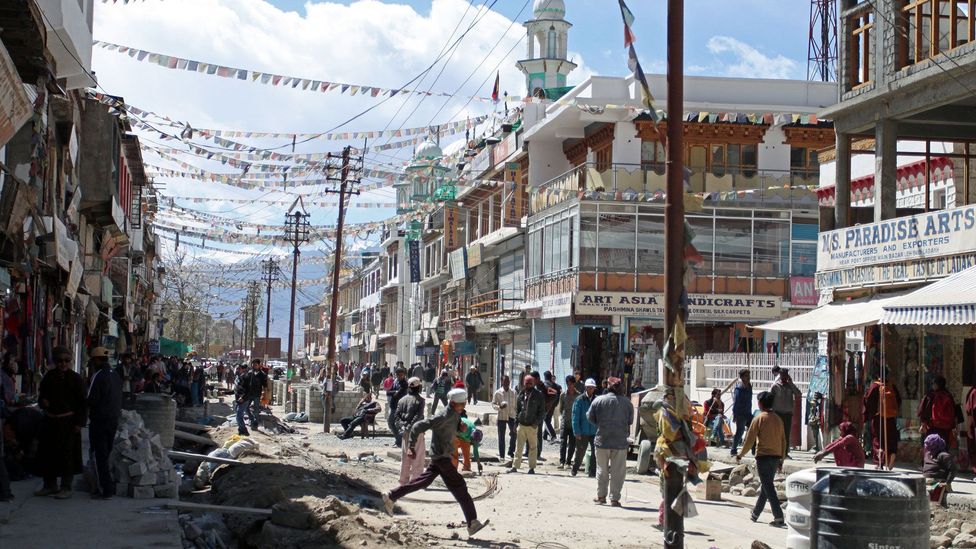
Leh, Ladakh's dusty majuscule
We set out for Sakti early on a Wednesday, post-obit the grade of the brilliant blue Indus River, passing breathtaking mountainside monasteries, dusty roadside diners and otherworldly plains of rock and arid earth. I travelled with Tsultim Dorjey, a sociologist and guide, who is serving equally my local lifeline.
Nosotros had not contacted Paljor'due south family alee of fourth dimension, assertive our odds of convincing them to speak with us about such a sensitive subject would be greater if nosotros described our mission in person. Now, I was plagued by doubt. Would they refuse to speak with us? Would they be offended? Would anyone even be dwelling?
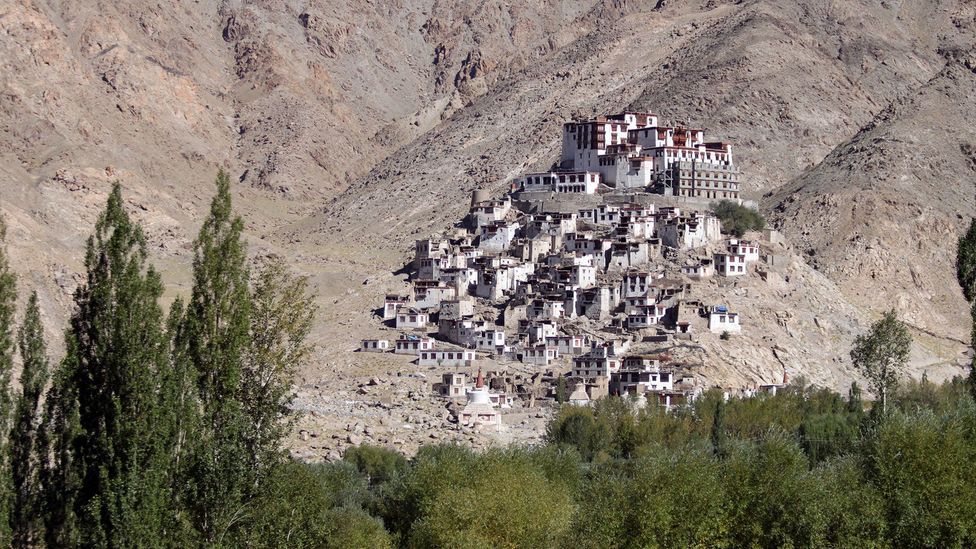
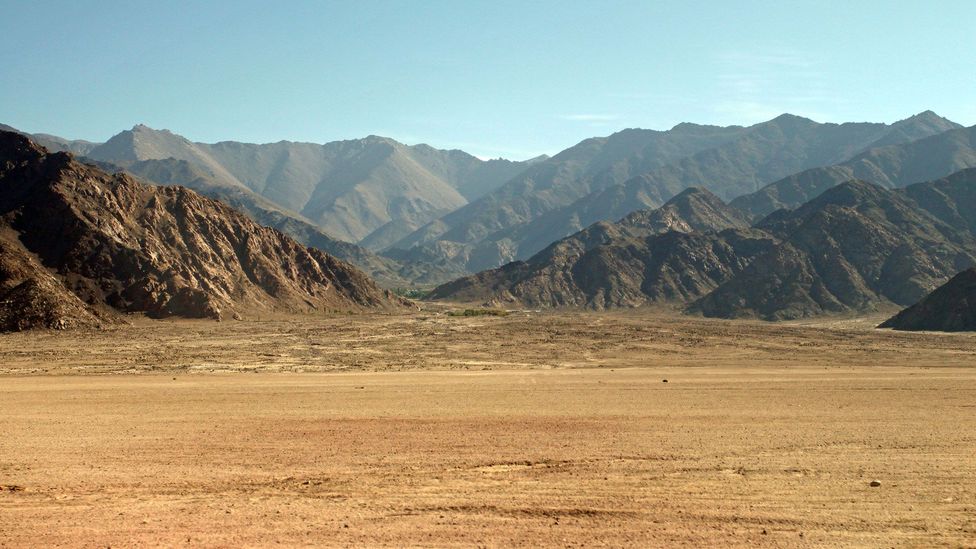
We passed dusty, otherworldly plains on our journey
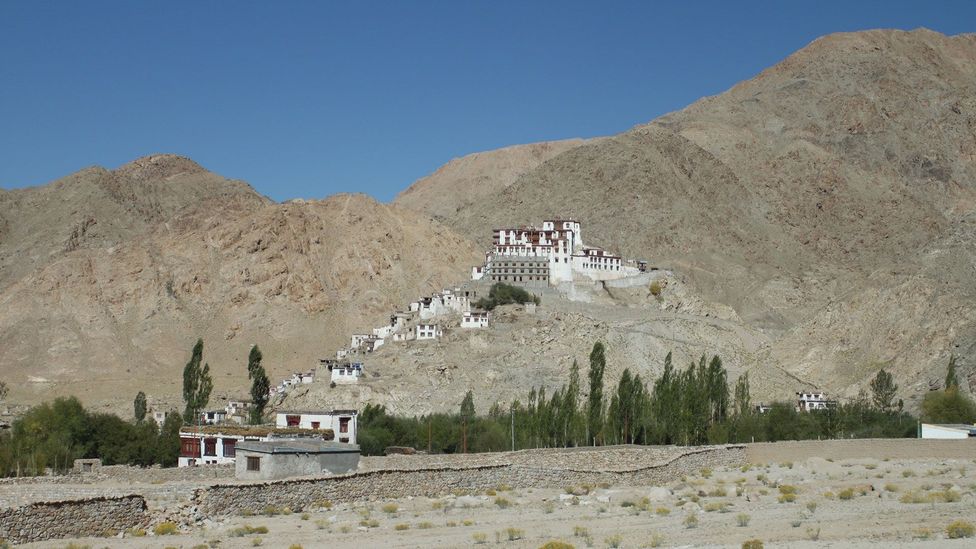
Passing remote villages on the way to Paljor's home
About an hour after leaving Leh, we were getting close. Tsultim jumped out of the motorcar, approaching an one-time human fingering some Buddhist prayer beads on the side of the route. Asking the man where nosotros could detect the Fana farm – Paljor's family surname – the man began gesturing emphatically downwardly the road. In a place similar Sakti, populated past just 300 or so households, everyone knows everyone else. "It's non far now," Tsultim reported, climbing back into the car.
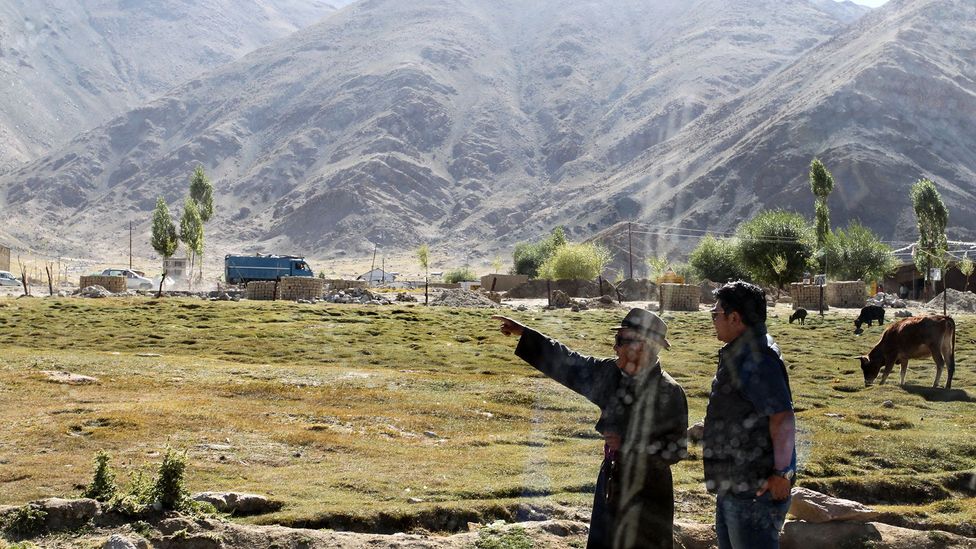
Getting directions in Ladakh
Minutes later, we arrived at a dark-brown gate, in front of an bonny two-storey home with large windows and fluttering Tibetan prayer flags adorning the roof. "This is it," Tsultim said. "Fingers crossed."
My breadbasket churned as we approached the forepart door, past a garden chock with petunias, marigolds and daisies and a xanthous dog, who gazed lazily at us from a sunny spot.
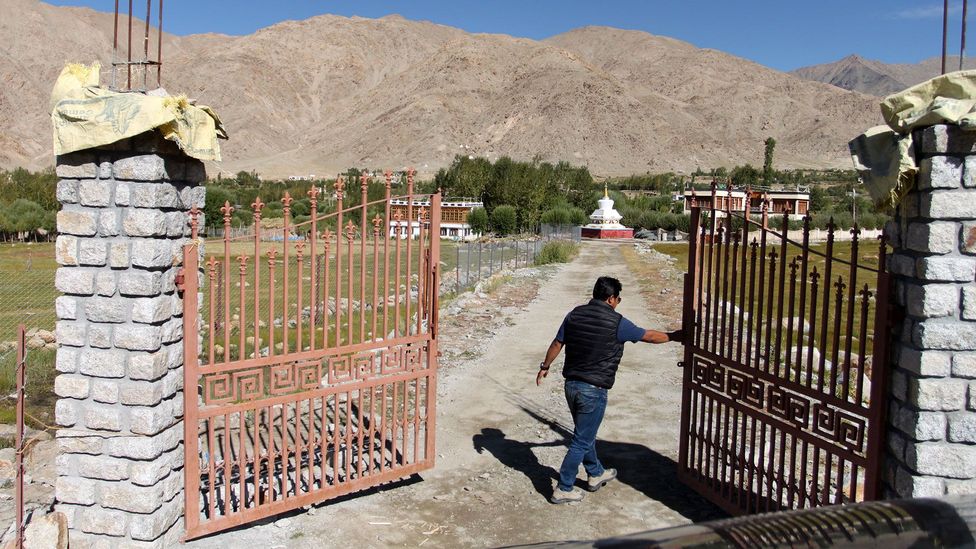
Arriving at the home of Paljor's female parent, unsure what to await
My fears were alleviated, however, the moment Tashi Angmo, Paljor'south mother, opened the door. At 73, her twinkling eyes and grinning confront appeared a decade younger. Radiating grandmotherly warmth, she greeted u.s.a. energetically – "Julay!" – and beckoned for united states of america to come inside, not fifty-fifty asking who we were or why nosotros were here.
Nosotros made our way into the sitting room, lined with couches, ornately carved tables and affiche-size photos of her grandchildren. Subsequently fetching a pot of steaming tea and a plate of biscuits, she and Tsultim exchanged niceties for several minutes. I didn't have to understand Ladakhi, however, to recognise the moment when Tsultim revealed the true purpose of our visit. Tashi Angmo's confront, until now all smiles, abruptly went slack, her numbed expression speaking of years of accumulated grief and loss. Yet when Tsultim asked if we could proceed with the interview, she said aye.
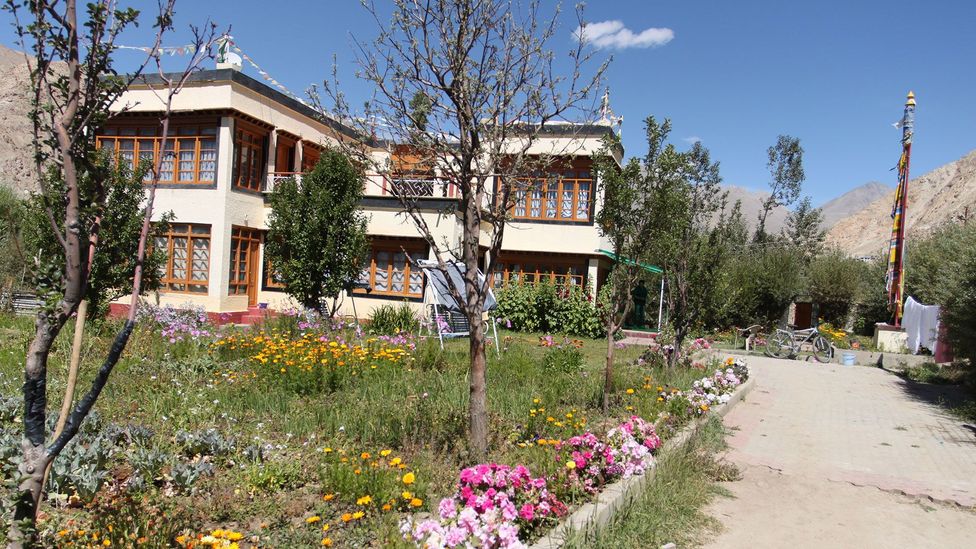
The house of Tsewang Paljor'due south family unit
A placidity middle kid with five siblings, Paljor was known in the village for his polite, compassionate manner. He had a big middle and natural kindness. Though good-looking, fifty-fifty as a teen Paljor never had a girlfriend – he was merely too shy. He once told his brother that he was more interested in dedicating his life to something bigger than himself than in getting married.
As the eldest son, Paljor no doubt felt pressured to provide for his family, which was struggling to make ends run into at their modest farm. Then after completing 10th grade, he quit school and tried out for the Indo-Tibetan Border Constabulary (ITBP), whose sprawling campus was located in nearby Leh, Ladakh's dusty capital. Formed in 1962 in response to increasing hostilities from China, the men who serve in that armed force specialise in high altitude landscapes – a necessity given that India'southward border with its domineering neighbour stretches across the Himalayas. To Paljor and his family'south delight, he fabricated the cutting.
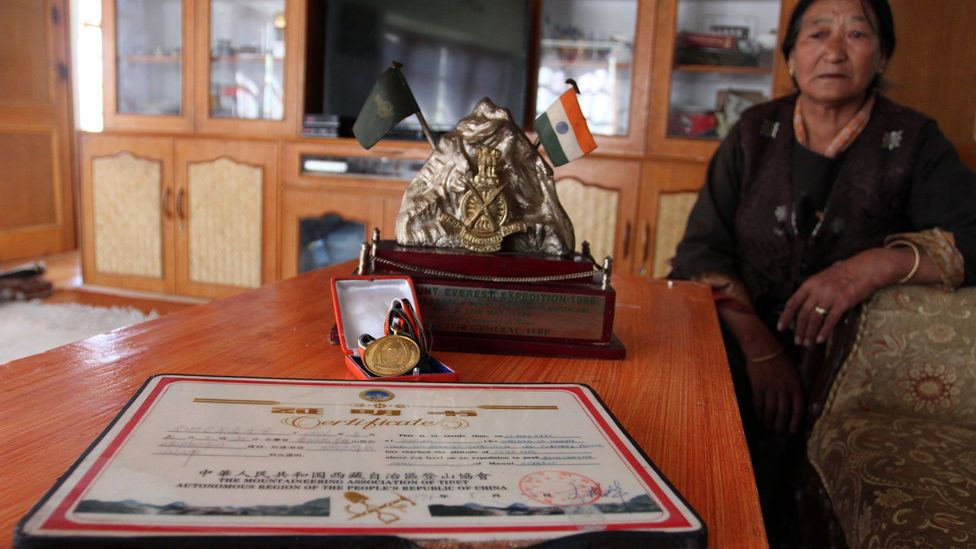
Tashi Angmo, with her son's possessions
Tashi Angmo was very supportive of his position at the ITBP, just he sensed that her support would only extend so far – certainly not to the peak of the world'south highest mountain. So when he was selected to join an elite grouping of climbers who would undertake a risky but grandiose mission – to become the kickoff Indians ever to acme Everest from its northward side – he chose not to reveal his true destination to her. "He told a small prevarication, that he was going to climb a different mountain," his mother says. "Only he also told some friends what he was actually doing, and word got back to the states."
Although Paljor's career already included many successful summits of other peaks, and Tashi Angmo'due south shelves brimmed with his certificates and awards, Everest struck her every bit beingness an exceedingly dangerous place. She implored her son not to go, merely he told her he had to. "He must have idea, if he climbs Everest, it will bring benefits for his family," she says.
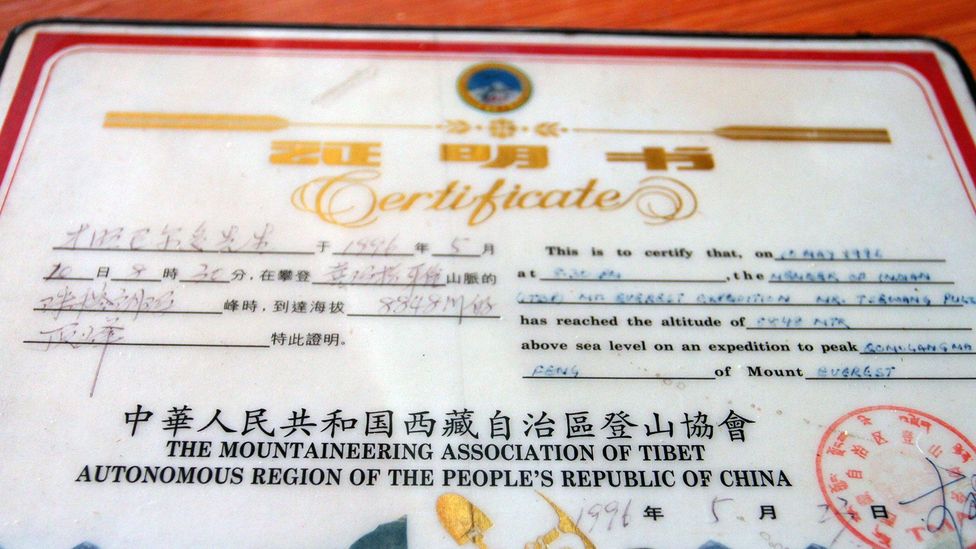
A certificate marking Paljor's ascent
But younger blood brother Thinley Namgyal was not worried. His brother was the strongest person he knew. "When he came habitation for holidays, we used to play around and boot his tummy, because it was like a rock," he says. "I always thought of him every bit a kind of Superman."
Thinley, who is a monk, met Paljor in Delhi days before he was due to leave; he gave his brother a approval before telling him adieu. "He'd just passed his health exam, and he was so excited to go to Tibet," Thinley says. "He wasn't nervous at all. He was actually happy almost all of this."
Thinley was the last family unit member to encounter Paljor alive.
**
Paljor was young, strong and experienced, but Everest presents multitudes of ways to have the life of even the nigh well prepared climber – falls, avalanches, exposure and more. The trunk also baulks at the insults it endures on the mountain. Sudden death – from heart attacks, strokes, irregular heart beat, asthma or exacerbation of other pre-existing atmospheric condition – is not uncommon, and lack of oxygen tin can trigger acute pulmonary or cognitive edema: life-threatening atmospheric condition that occur when blood vessels begin leaking fluid into the lungs or brain.
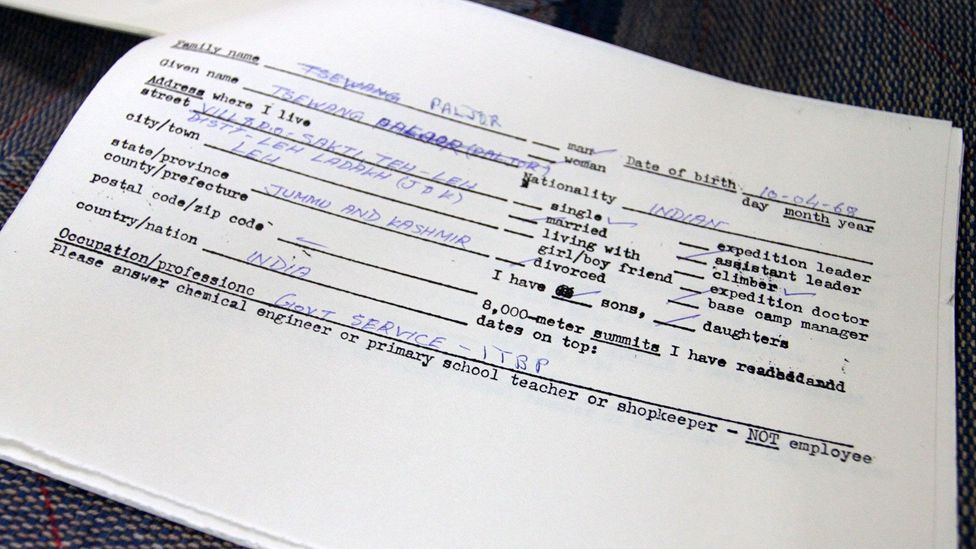
Documentation for Paljor: resident of Sakti, climber, no children - from the files of Elizabeth Hawley
Not anybody on the mountain shares the aforementioned odds of dying under any given circumstance, however. In a retrospective written report of 212 climbing deaths on Everest from 1921 to 2006, Paul Firth, an anesthesiologist at Massachusetts General Hospital in Boston, and his colleagues plant that well-nigh Sherpa deaths occur at lower altitudes, reflecting the unavoidable run a risk of traversing the Khumbu icefall – an unstable glacier field laden with business firm-sized water ice blocks and gaping crevasses. Deaths at higher elevations, on the other hand, nigh entirely belonged to paying clients and Western guides, and more than 50% of deaths above 8,000m (26,000ft) occurred after climbers had summited and were on their manner dorsum downwards. "I was surprised at how few Sherpas have died loftier up," Firth says. "But the numbers are glaringly obvious."
These findings probable reverberate a multitude of factors, including Sherpas' possible superior adaptations to hypoxic conditions, their greater feel on Everest and their lack of vulnerability to summit fever – an overwhelming desire to achieve a mountain's superlative that causes climbers to disregard rubber. "People make decisions based on success, not on survival," says Ed Viesturs, the first American to accept climbed all xiv of the globe's 8,000m peaks, and the 5th person to practice and then without supplemental oxygen.
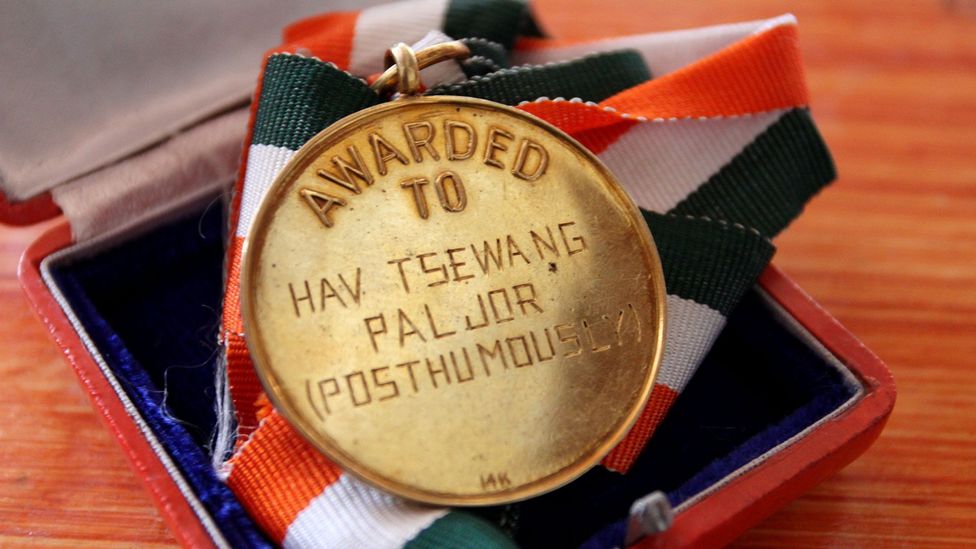
A medal awarded after Paljor's death
When Mark Jenkins, a journalist, author and adventurer in Wyoming, was on Everest in 2012, five people died on a single solar day. Sherpas he interviewed told him that most of the fatalities belonged to clients who had refused to turn effectually. "Your Sherpa volition tell you, 'You're besides ho-hum, you have to turn around or you'll die,'" he says. "And some people don't."
"Mountains don't kill people, people kill themselves," he says.
(Read part two in this serial, near the trouble of Everest's 200+ bodies.)
Viesturs, who once concluded a climb on Everest inside 100m (300ft) of the summit because conditions did not look good, credits his survival to always listening to the mount and knowing when to turn back. "My rule was that climbing had to exist a circular trip," he says. But many of Everest'south victims, Firth contends, are likely people who don't recognise early warning signs because they lack sufficient experience to know what's normal, or else are experienced climbers whose judgment is muddled by the furnishings of distance. By the time they realise they are in trouble, it's too tardily.
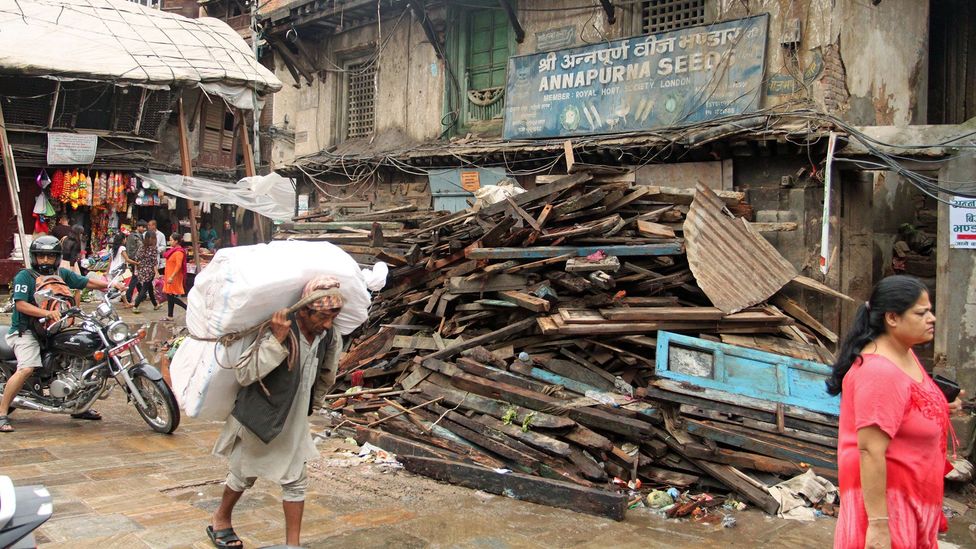
Kathmandu, where many Everest journeys begin
Jenkins estimates that one-half the climbers on Everest today do non belong at that place. "Its not my opinion, it's just a fact," he says. "The highest some of them have ever been is up a skyscraper."
"Without Sherpas, 98% of people who climb Everest couldn't," agrees Billi Bierling, a Kathmandu-based journalist, climber and personal assistant for Elizabeth Hawley, a sometime announcer, at present 91, who has been chronicling Himalayan expeditions since the 1960s.

Files of expeditions, kept by Elizabeth Hawley
On Everest, things were proceeding without a hitch for Paljor and his comrades. The Indian trek was well connected on the mountain, with a luxurious communal tent that all climbers, regardless of nationality, were welcome to visit.
Commandant Mohinder Singh, who led the team, told me near the expedition at his home outside of San Francisco, where he now manages an apartment circuitous: "Nosotros were the peak class in the world."
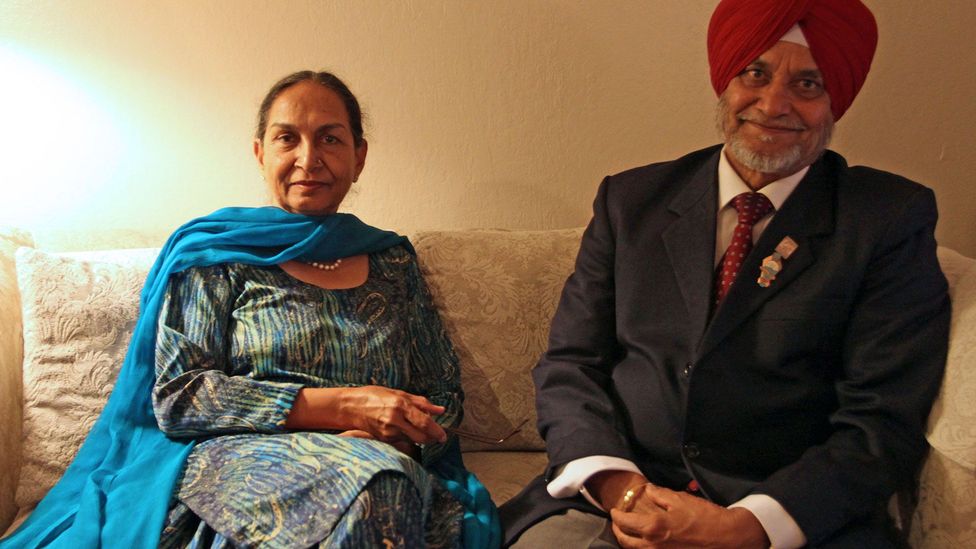
Mohinder Singh and his wife at their home outside of San Francisco
For his strength and enthusiasm, Singh selected Paljor to be office of the first summit attack team, forth with climbing partners Tsewang Smanla and Dorje Morup, and deputy leader Harbhajan Singh. "Paljor wanted to practice many things in his life," says Singh, who believes the swain looked upward to him as a sort of father figure.
He recalls Paljor as being very talkative, "like a child," and that he loved to attempt difficult rock climbs. "He looked similar a monkey when he climbed," Singh says. He besides remembers Paljor'southward love of roast chicken; his tendency to sing in his free time; and that he was e'er volunteering to take on difficult jobs. "He was very helpful like that," Singh says.
Singh was confident in Paljor, Morup and Smanla'south skills – they were all from Ladakh, and had all proven themselves in the field. However, almost immediately, the expedition was marred by "mistake after mistake," in which the climbers "failed to follow clear instructions," Singh after reported in his official business relationship of the events.
The problems started on the morning time of ten May, when the team was delayed by strong wind and then overslept. They did not gear up out from Military camp VI until 08:00, rather than 03:30 as planned. Given the extremely tardy start, they decided to move further upwardly the mountain to fix ropes rather than attempt the top, since doing so would guarantee descending through the Death Zone in the dark – the area above viii,000m where climbers often lose their lives.
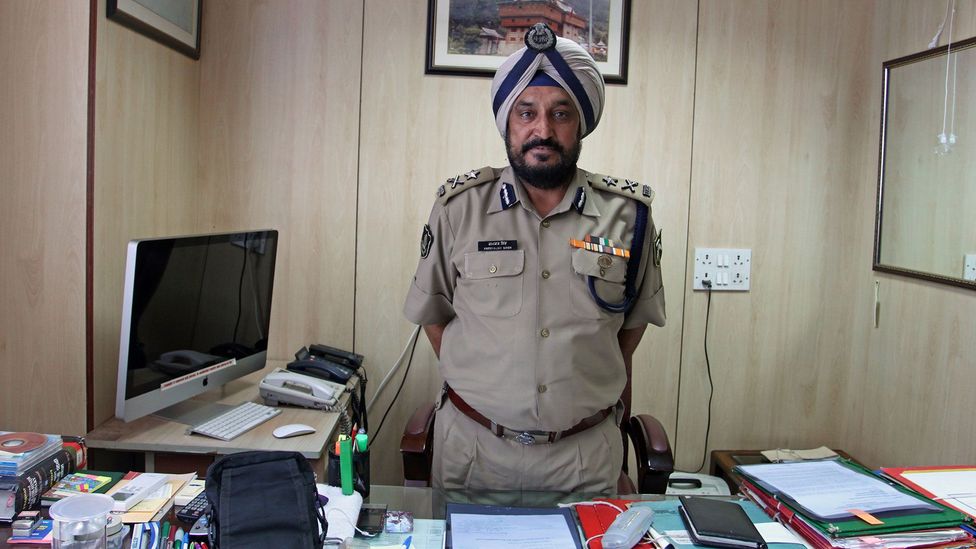
Harbhajan Singh, deputy team leader, and the only survivor of the expedition
By 14:xxx, the squad had made significant progress, simply the wind had begun to pick up once more. Singh had given the team strict orders to turn around at 14:30, or 15:00 at the latest. Harbhajan Singh, however, was lagging far behind the three Ladakhi men. When he signaled for them to cease and return to army camp, they either did not see him or ignored him. Watching equally they pushed on, the frostbitten Harbhajan Singh had no choice but to descend back to Military camp 6 without them.
Speaking nigh this moment 19 years subsequently from his brilliant office in New Delhi, Harbhajan Singh, now an inspector general at the ITBP and recipient of the Padma Shri, India's 4th-highest honor, gets a distant look in his eyes.
"When we lost these three people, I was the fourth, I was with them," he says, gazing across me. "I'm in front of you today, just if I would have tried, I would be gone. It'southward only God'due south gift that I am alive."
Summit fever, he suspects, had overtaken his men.

Everest has killed nearly 300 people (Credit: Getty Images)
At last, at xv:00 that afternoon, an anxious Singh, pending news from Advanced Base of operations Camp, heard his walkie-talkie sputter to life. Information technology was Smanla.
"Sir, nosotros are heading towards the summit," Smanla appear.
Singh was taken aback. "Oh no! The weather is very deceptive, bad."
Smanla was not to be dissuaded, even so, and pointed out that the summit was less than an hour away and that all three men felt fit.
"Don't be overconfident," Singh insisted. "Listen to me. Please come downwards. The sun is going to set."
Smanla shrugged off the warnings, and put Paljor on the phone. "Sir, delight permit us to become up!" Paljor said, his phonation brimming with pride. Merely just then, the radio cut off.
It wasn't until 17:35 that Singh heard back from his men. A overflowing of relief and excitement washed over him every bit Smanla announced that he, Paljor and Morup were continuing on the summit. Fifty-fifty as Singh stressed the importance of returning as presently as possible, he began looking frontwards to the triumphant message that he would send to New Delhi announcing his squad'southward victory.
Celebrations immediately ensued, both at home and at military camp. The men had simply set up a tape for their country. Whether Paljor and his teammates really summited, however, was after called into question. Krakauer and others suspect that the men unintentionally stopped 150m (500ft) brusque of the peak, believing – due to increasingly bad conditions and the mental haze of high altitude – that they had reached the tiptop. Despite the dubiety, however, they are credited with the ascent, as the trophies Tashi Angmo later received on behalf of her dead son attest. As Singh says: "They made it, they accepted that they fabricated it, and I confirmed it."
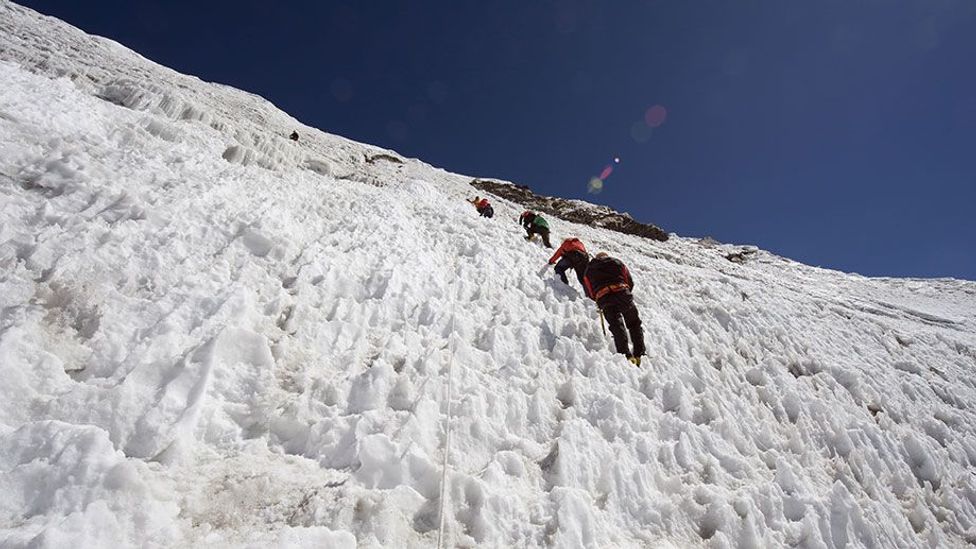
In their quest to reach the top, many climbers get 'superlative fever', disregarding risks (Credit: Rex)
Yet the celebrating feeling at camp was to be short-lived. Shortly later on Smanla called, the weather, which had been steadily deteriorating, broke. The infamous 1996 blizzard had arrived, cloaking the mountain in a fury of snow and wind. Trying to go on his fears at bay, Singh told himself that the men would be fine, that they had dealt with worst weather in the past. If they hustled, they could fifty-fifty make information technology dorsum to Camp VI by midnight. "All the same," he after recalled, "this did not happen."
Ideals at 8,000m
By 20:00 on the nighttime of Smanla, Paljor and Morup's ascent, Singh could no longer contain his worry. According to his official business relationship, he decided to approach a Japanese commercial climbing team from Fukuoka for help. 2 of the team's climbers, Hiroshi Hanada and Eisuke Shigekawa, planned to go out for the acme that night.
Using a Sherpa who spoke some Japanese to help translate the chat, Singh "impressed upon [the Japanese leader] the seriousness of the situation." Singh reports that, in his presence, the Japanese leader radioed his team at Camp 6 to explain the situation, and then told Singh that the Japanese climbers would do all they could to help the stranded Indians if they encountered them on their style to the summit. "The Sherpa [translator] ensured us on his behalf that the Japanese would treat this crunch as their own," Singh writes.
By morn, the tempest had died down and the Japanese were able to set out for the tiptop. At 09:00, the leader of their squad informed Singh that his ii climbers had encountered Morup, who was frostbitten and lying in the snow. They had helped him clip into the next fixed line, but then connected on their push to the summit. "We were dismayed," Singh writes. "The black tea that the Japanese served us tasted blackness indeed."
Two hours later, nether a "clear and serene heaven," the two Japanese climbers and their iii Sherpas passed Smanla and Paljor, but once again did not stop or return any help. "Why did they non give even a drop of water to our dying men? What nigh mountaineering ideals?" Singh writes. "The Japanese had left us with little hope."
The Japanese team, withal, afterward contested this version of events. The "baseless accusations" made against them, they stressed, entirely hinged on flawed, one-sided information. Back in Japan, they held a press conference and issued an official report stating that Shigekawa and Hanada had never been informed that the Indian climbers were in any sort of trouble. While they did encounter several climbers on their mode to the summit, Hanada said, "we did not see anybody who seemed to be in trouble or dying."
The written report they issued also emphasised that to a higher place 8,000m, "information technology is mutual sense" that every climber should be held accountable for their actions, "even on the brink of death."
The climber's code of ethics, issued by the International Climbing and Mountaineering Federation, specifies "helping someone in problem has accented priority over reaching goals nosotros fix for ourselves in the mount." Near have this to centre. "Saving one life is more important than summiting Everest 100 times," says Serap Jangbu Sherpa, the first person to climb all viii of Nepal'south viii,000m peaks, and the get-go to meridian K2 twice in ane year. "We can always go dorsum and summit, but a lost life never comes back."
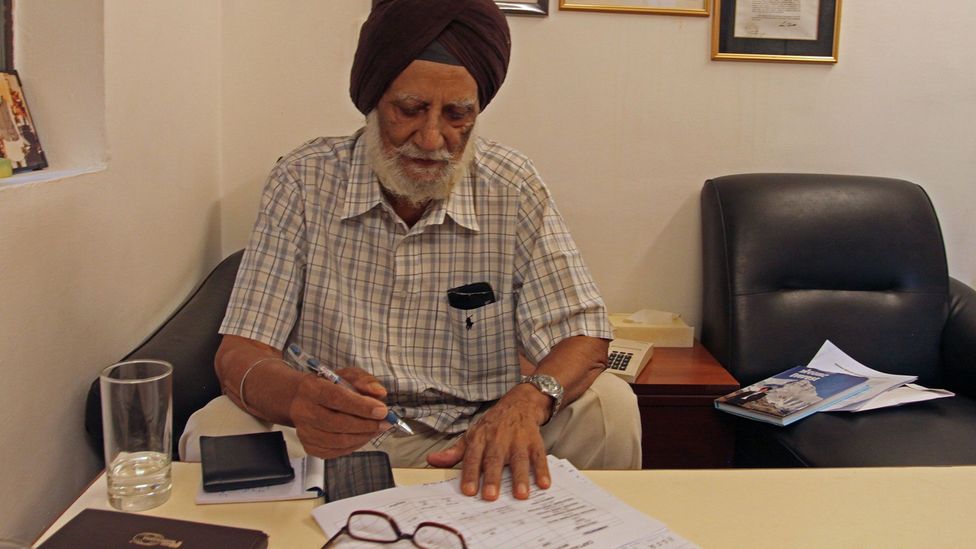
Captain MS Kohli, at his hotel in New Delhi, the Legend Inn
"To say that everyone should await after himself, that no one should aid another team is nonsense," adds Captain MS Kohli, a mountaineer who in 1965 led India's kickoff successful expedition to summit Mount Everest. "That is absolutely against the spirit of mountaineering."
That unproblematic dominion becomes more complicated, nonetheless, when commercial clients are involved. After paying many thousands of dollars for safe passage to the summit, it's less clear what those climbers' role is, should they run into someone in need and likewise, it's likewise unclear to what extent a guide can exist depended on to salve a client's life at the possible toll of his own.
Add to that the fact that, above 8,000m, decision-making and critical thinking skills are severely impaired. "The nearest thing I can compare it to is like being quite seriously drunkard, only not fun," Firth says. As oxygen diminishes, plans and morals formulated at lower elevations frequently lose their clarity.
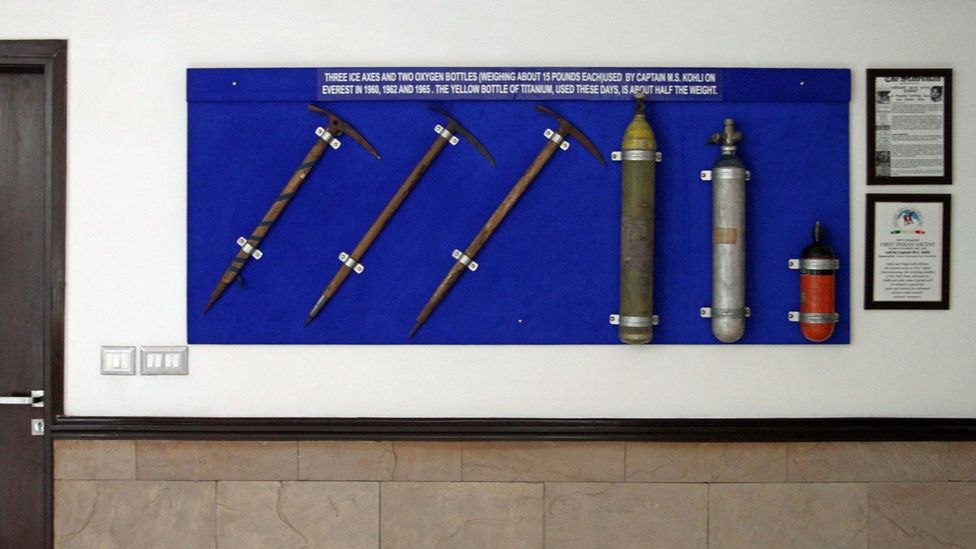
Equipment used past Helm MS Kohli on Everest ascents
"People are then fascinated by this when they're sitting in their living room reading Outside mag, but the dynamics of what information technology's like to be upwardly there are really hard to cover from downward hither," says mountaineer Gulnur Tumbat, an associate professor of marketing at San Francisco State University. Even if a climber wanted to help someone in demand, she points out, he would probable exist putting his ain life on the line to exercise so. "Above 7,000 or 8,000m, there'south not much you can practice," she says. After experiencing the effects of high altitude herself, she was not surprised to find in her research that people at Everest tend to exist individualistic. "There'due south actually non that much camaraderie up high on the mountain," she says. "I'm not saying it's a bad thing or a adept thing – information technology's well-nigh necessary to be that way, given the conditions."
It also doesn't assist that, for many people – no doubt Shigekawa and Hanada included – a trip to Everest is seen equally a once-in-a-lifetime opportunity. The amount of fourth dimension, money and energy invested in the mountain tin can encourage selfish and reckless decision-making. "There's a mystique to Everest where people come to the determination that traditional rules don't employ, whether that ways how much risk they're willing to have or what the value of reaching the top of the mountain is to them," says Christopher Kayes, chair and professor of management at the George Washington University in Washington, D.C. "I recollect the closer y'all go to your goal, the more likely y'all are to come up up with rationalisations for foregoing morals or values."
In some cases, he continues, it might "literally mean throwing caution to the wind." In others, it might mean leaving a fallen climber behind who is deemed across helping. (Bierling points out, all the same, that rescues happen every yr – they just don't brand the news like the deaths do.)
Cloud of dubiousness
Neither Shigekawa nor Hanada responded to interview requests for this story, simply Koji Yada, ane of the 2 men'due south climbing leaders, recalled the incident to me when I met him in Fukuoka. "Every bit I understood the situation, the [Indian] climbers were wearing heavy equipment, so it was difficult to tell who they were," he says, adding that he does non know whether Shigekawa or Hanada sensed that the unidentified climbers were in distress.
"I take no idea what I would do if I were in the same situation [equally them], merely I cannot help thinking that I could practise nothing," he says. "Someone might say that's inhuman and selfish, but there's nil I can exercise."
"Eight thousand metres and upwardly is a totally different world," he continues. "We often use the give-and-take self-responsibility to depict the situation there."
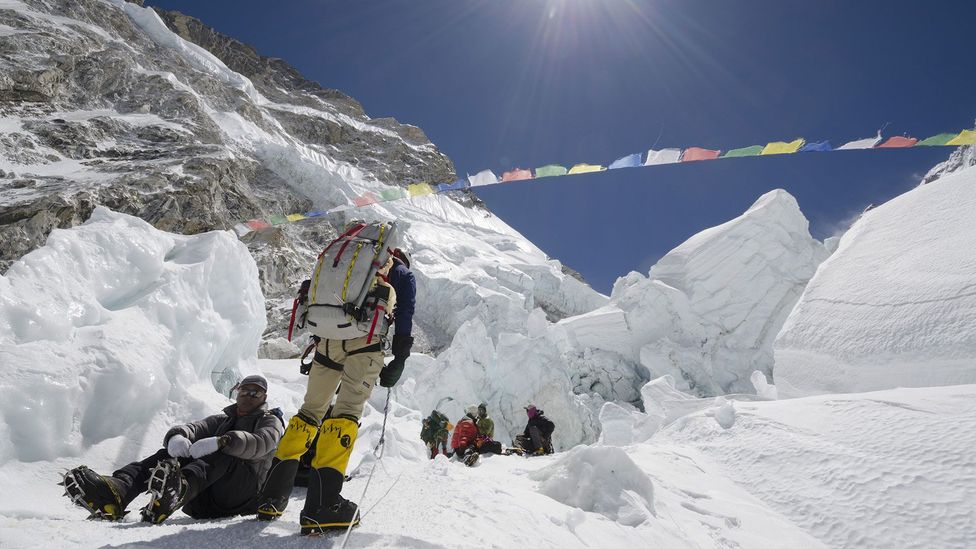
What responsibility should climbers have for their boyfriend mountaineers? (Credit: Rex)
As with then much that happens on Everest, the events of that May day in 1996 are no uncertainty clouded by subjectivity, self-interest and the listen-clouding furnishings of high altitude, and nosotros will likely never really know what transpired in the last hours of Paljor, Smanla and Morup'due south lives.
When things practise become awry, media frenzies ensue, and the typical reaction is to analyse what went wrong and then dribble a handful of lessons learned. A few business schools even utilise the 1996 Everest disaster every bit a teaching tool. Only some experts believe that there simply is no making sense of what transpires higher up 8,000m.
"It is difficult to know for sure what actually happens during a climbing disaster among teams of ambitious people at 8,000m in howling winds and in a land of hypoxia, dehydration and exhaustion," says Michael Elmes, a professor of organisational studies at Worcester Polytechnic Constitute in Massachusetts. "I don't remember events like the 1996 disaster tin exist analysed or anticipated, and I'g hundred-to-one that there are means to prevent time to come disasters."
**
Tashi Angmo has trouble recollecting the days following her son's decease. She does remember two men from the Indo-Tibetan Border Police coming to her door and asking if she was Paljor's female parent. They told her that there had been an accident on Everest, and that he was missing. The ITBP had deployed a battalion to search for him, they said, and had even sent a helicopter. Simply despite their efforts, he seemed to have vanished.
Looking back now, she wonders if the men were telling the truth. "Maybe they looked for him and perchance they didn't," she says. "But if the right attempt had been put in, I believe that he definitely could take been constitute and saved."
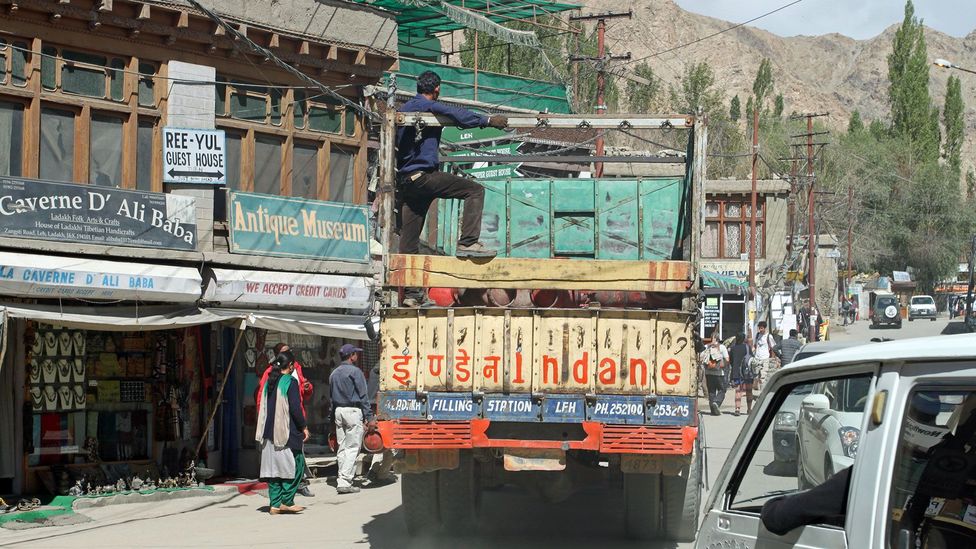
Leh is home to a branch of the Indo-Tibetan Border Constabulary, Paljor'due south former employer
Later receiving the news, because there was no trunk, and because the officers told Tashi Angmo that her son was missing – non expressionless – she spent the next two days travelling to all the local monasteries, performing thimchol, an offering for wellbeing. "It would accept been better if they had found the trunk," she says. "I kept hoping he'd come dorsum, because they never found the body."
Eventually, though, her relatives insisted that she face reality. Paljor was not going to be rescued, and he would non exist coming domicile. "'Missing' is a term the ITBP is using to relieve you," they gently told her.
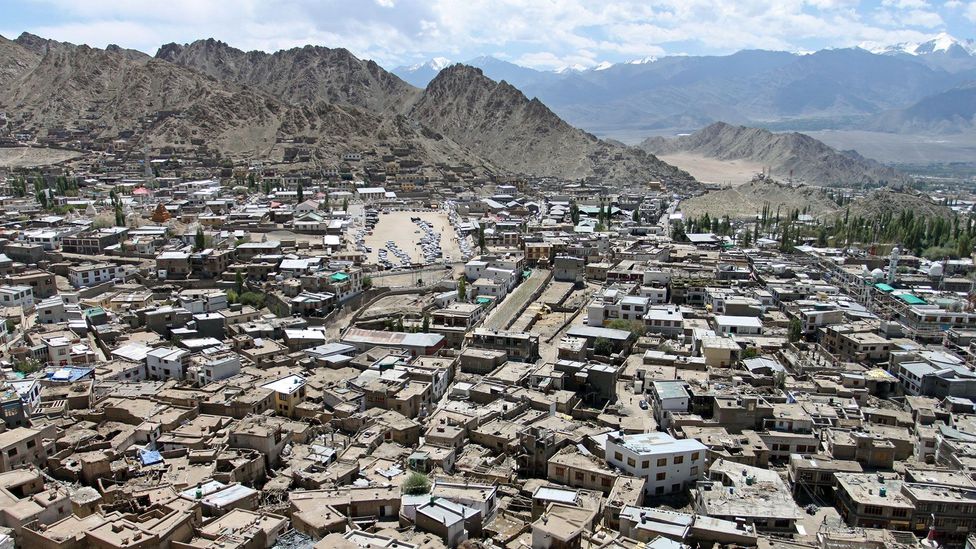
The family unit somewhen held a funeral and also attended a anniversary put on past the ITBP in honor of the iii Ladakhi men. "I was like a dead body," says Tashi Angmo.
Her grieving process was farther exacerbated by bitterness that presently developed toward the ITBP. Though officials promised the family that they would exist well taken care of, they received an insurance sum of only $3,690, followed by alimony payouts every other month of nigh $36.00 – an amount, Tashi Angmo says, that "won't even last iii days."
"Shame on ITBP! They are not good!" she told me, weeping. "A child is priceless, money is nothing. Merely we are the affected family. I lost my child. They should honor their promises."
Though Paljor died a hero, his family received pittance while his body would remain on the mountain, becoming a morbid fixture of the landscape. When Everest takes a life, information technology also keeps it. Eventually, he became Greenish Boots – a climber without a name that people would pass by every year en-route to their own personal glory.
It wasn't, however, the last chapter in Paljor'due south story…decades afterward, he would disappear. In part two, I will investigate what happened next, the growing problem of the 200+ bodies yet on Everest – and the intriguing psychological reasons why people keep to climb this deadly mount.
Source: https://www.bbc.com/future/article/20151008-the-tragic-story-of-mt-everests-most-famous-dead-body
0 Response to "But Almost as Soon as the Green Came the World Turns Back to Brown Again"
Postar um comentário